
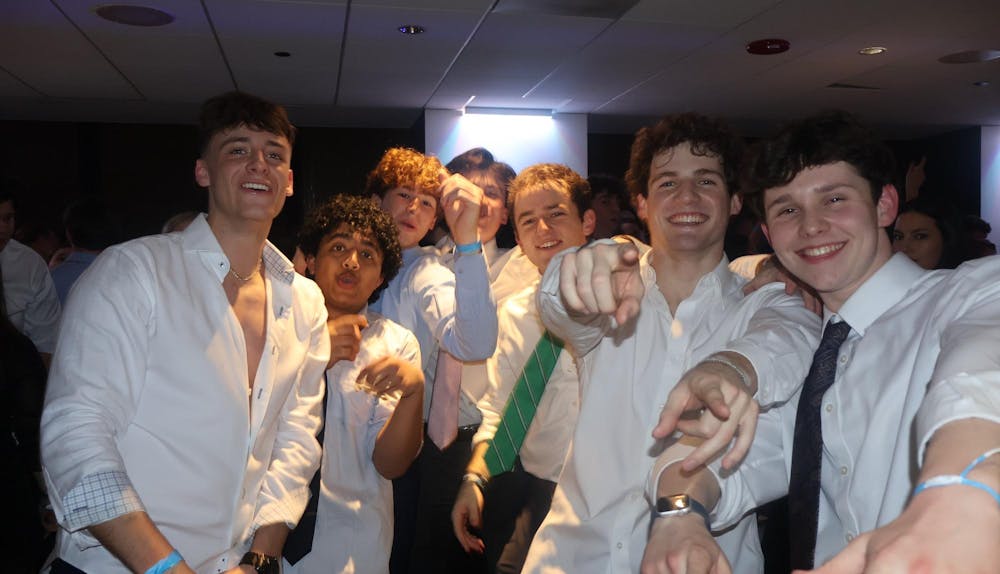
Each of Notre Dame's 32 residence halls host their own formal, but these events vary in location, cost and itinerary. Formals are held everywhere from South Dining Hall to downtown Chicago, with corresponding event logistics and planning processes at varying levels of sophistication.
Formals that are held on campus are typically planned by students. Each residence hall appoints a dance commissioner who oversees the coordination of the formal.
“As the dance commissioner, I would update our hall president about the events and she would inform the rector about what is happening ... It’s completely student run which is really cool,” Flaherty Hall dance commissioner Lauren Whitlatch said.
Residence halls often choose to pair up for their formals to increase their budgets and streamline the planning process
Whether they partner with another dorm or have a formal for just their residents and their dates, commissioners submit information about which venue and dates they prefer up to a year before the formal.
“We had to have everything ready to go by April 1 [of the previous year]. A lot of us were communicating in advance during March, and we picked to do a dance with ‘Cav’ again. You have to have everything planned out a year in advance, which is kind of crazy,” Whitlatch said.
Dance commissioners are in charge of picking themes for each formal, which can vary from “masquerade” to “Great Gatsby.”
“We ran by the girls different theme ideas they wanted and decided our theme would be ‘all that glitters is gold’ in honor of the national championship that we almost won,” Whitlach said.
Formals held off-campus are more complicated to plan, so rectors are often in charge of coordinating with the venue and arranging transportation.
Duncan Hall’s formal is at a high rise building in Chicago, and rector Nic Schoppe started planning for the event a year in advance. “Planning involves contacting the vendors that we’ve worked with for a long time: the bus contract, vendor, catering, DJ… the big lift is making sure that the contracts can be approved through the University to make sure we’re in compliance with everything we need to be,” Schoppe said.
Sophomore Fiona Denning attended Duncan Hall’s formal in Chicago and noted that the timeframe of the event was significantly extended. “Compared to an on-campus formal, the biggest difference was the timing. I started getting ready at 1 pm for a formal that started at 8 because we had to take a bus to Chicago,” she wrote.
These events vary in cost. The Student Activities Office (SAO) and University budget allocates a certain amount of money to each residence hall for formals. Ticket sales provide additional funds for catering food, arranging transportation or hiring a DJ.
“We use the money we make from ticket sales for the food budget, and we use money from ND Day and then also the money we receive from SAO and hall funds from the university,” Whitlatch said.
For an on-campus residence hall formal, tickets are usually around $10 per person.
To attend Duncan Hall’s Chicago high-rise formal, students paid $125 per ticket. “It’s a very, very expensive event. A lot of that cost unfortunately has to be pushed off to the students because our hall budget just doesn’t cover it. The event usually costs double what our hall budget is,” Schoppe said.
To alleviate costs, Schoppe is looking into new venues for Duncan’s formal next year. “We are currently looking at potentially changing the venue for future years just based on rising costs … We’re looking at other options, still in Chicago, to bring costs down so students can still have a good experience but not have it cost as much,” he said.
Reflecting on her experience at the Duncan formal, Denning wrote, “The formal overall was very fun. We spend so much time on campus going to the same locations for formals, a switch of pace made the whole event feel really exciting.”


