
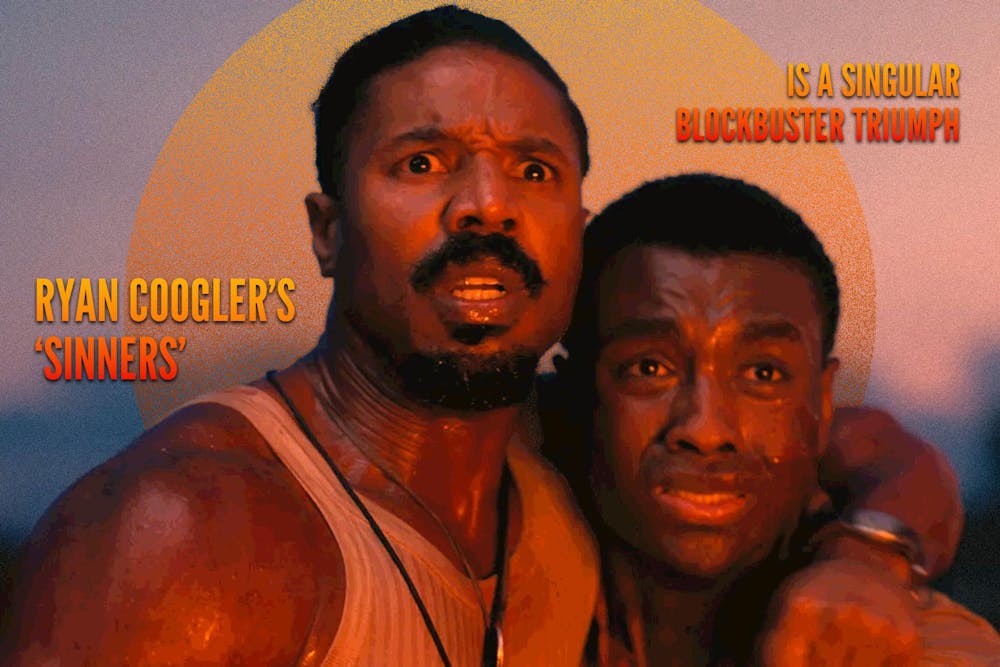
Ryan Coogler is one of Hollywood’s most brilliant young directors. However, for the past decade, he has tragically been trapped in the Marvel machine, directing the “Black Panther” films. Despite those being some of Marvel’s best, I’ve been itching to see him make an original film free from all franchise constraints, superhero conventions and Kevin Feige meddling. My wish has finally come true with “Sinners,” which has surpassed all my expectations. Coogler’s Southern Gothic tale of vampires is bursting with an abundance of ideas, tones and styles, making it a profound and exhilarating triumph.
“Sinners” unfolds with remarkable patience and attention to detail. Set in the 1930s, the film follows two twins, Smoke and Stack (both played by Michael B. Jordan), returning to their small Mississippi town after making it big running with gangsters in Chicago. They want to open a juke joint, and the film’s first half is entirely focused on their recruitment and procurement efforts to get it up and running in one day. They visit many old friends and ask for their help, with each interaction deftly revealing years of prior relations and drama. Each side character is fleshed out, compelling and illustrates some unique theme. It’s immensely satisfying to watch Coogler so assuredly set up all these moving pieces in the first half. The world he crafts is so palpable and engrossing. And while the historicity is all there with lavish costumes and layered environments, Coogler is not using them as a crutch; he more importantly hooks you on the emotions and the aspirations of these characters within the Jim Crow South.
Once we reach the juke joint’s opening night, Coogler enters a whole new realm of cathartic filmmaking. He stages larger-than-life celebrations of music and community, with a joy and eroticism that touches the transcendent. There’s a specific one-shot where the space-time continuum in the juke joint bends as decades of black music interweave. It’s a beautiful and stirring sequence that could have been corny in the hands of a lesser director. Coogler, however, is hesitant to paint the twins’ enterprise as something purely altruistic. There’s an ambivalence of whether the two are community heroes trying to provide a safe third place or sleazy capitalists looking to make more money after their time in Chicago went sour. The film presents a dialectic on capitalism as both a source of empowerment and subjugation. Entrepreneurship is a way for black people to gain more power and control in a racist country, but it comes at the cost of exploiting vices and ruthless commerce. How can capitalism provide liberation to oppressed communities when it often relies on hierarchy, exploitation and internal division within these communities to sustain itself? Coogler daringly probes this paradox.
It is at this halfway point, however, that things also take a gory, supernatural turn. Sammie, played by Miles Caton in an exceptional acting debut, and his performance at the juke joint were a little too good, causing a vampire named Remmick (Jack O'Connell) to descend upon the juke joint. Remmick wants to convert the patrons and Sammie into vampires and use Sammie’s transcendent music to exalt their community and connect with the spiritual realm. Just as he did in “Black Panther,” Coogler makes his antagonist occupy a compelling moral gray area. Remmick, an Irishman who has also faced discrimination in the Anglosphere, tries to convince Sammie and his friends that becoming a vampire is the best escape from the evils of the Jim Crow South, that trying to make it on their own terms — empowering the black community from within — is futile. The KKK will get you, capitalism is a trap, the North is just as racist as the South — everything is a dead end. To a certain extent, his offer is alluring, but his suicidal fatalism is ultimately worthless and just a cheap escape from the problem at hand. His solution is a self-destructive assimilation into a vampiric community that subsumes all peoples and cultures into an amorphous, hokey blob. Sammie refuses to let his artistry be co-opted and instead fights for his integrity. It’s here that it becomes evident that Sammie is a self-insert of Coogler, a filmmaker who’s had to constantly deal with corporations desiring his talent for mass art. The film is an ode to art as a pure, powerful interface with ourselves and the world around us.
There’s so much more that could be said about “Sinners” — Autumn Durald Arkapaw‘s gorgeous and warm cinematography, the rich ensemble performances, the commentary on Christianity in the black community — but that’s what makes it so exceptional. Coogler has crafted a film that’s immediately exciting and fun, full of sensuality, effective horror and endearing characters. But it’s also loaded with complex, incisive themes and subtext. It’s a brilliant tightrope act that sets a new standard for blockbuster films. Here’s to hoping Warner’s next big auteur swing — Paul Thomas Anderson’s “One Battle After Another” — is a similar commercial and artistic triumph.


